
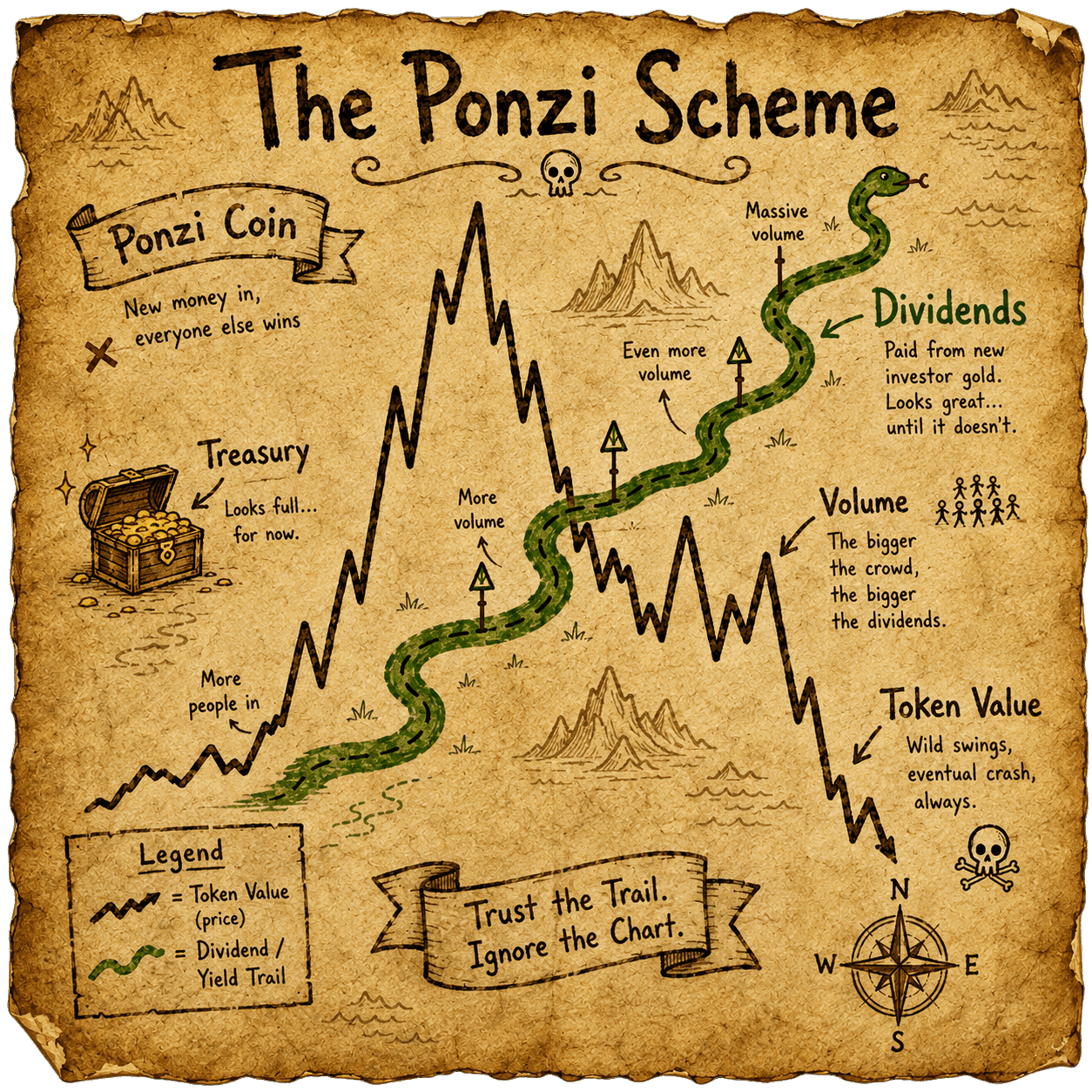
The Ultimate
Ponzi Scheme
A PoW. Proof of work with the hash function removed and the expenditure left intact: metered in supply destroyed rather than joules dissipated, difficulty repriced by participation rather than by a target, and settled against revenue the market has already produced.
What proof of work actually is
A hash function takes any input and returns a fixed length number. It is one directional. Given the output there is no method for recovering the input, and no method for steering the input toward an output you want. The only available technique is to try a value, look at the result, and try another.
Bitcoin uses this to run a lottery that cannot be rigged. A miner assembles a candidate block, appends an arbitrary number called a nonce, and hashes the whole thing. If the resulting number happens to fall below a target value, the block is valid and the network accepts it. If it does not, the miner increments the nonce and tries again.
There is no cleverness available. No shortcut exists, no partial credit accrues, and a machine that has failed ten trillion times is in exactly the same position as a machine that just switched on. The process is memoryless, which is the property that makes the whole thing work.
The target is adjusted every 2016 blocks so that somebody, somewhere, gets lucky roughly every ten minutes. As more machines join, the target tightens. The network does not get faster. It gets harder.
Inside the machine
A modern rig is a single purpose object. It computes one function, SHA-256, and it can do nothing else. It is not a computer that has been pointed at mining. It is a heater with an opinion about numbers.
Electricity inThe only real input. It is metered, it is paid for, and it does not come back.
Heat outAlmost all of that energy leaves the box as heat within seconds of entering it.
The guessingChips try nonces in parallel, trillions per second. Every wrong guess is discarded and never reused.
A solutionOne guess lands under the target and becomes a block. The rig has nothing else to show for the interval.
Watch what the box actually consumes and produces. Electricity goes in and is metered. Heat comes out, almost immediately, in nearly the same quantity. Somewhere in the middle, trillions of guesses per second are made and discarded. Over a ten minute interval, a rig will produce hundreds of trillions of failed hashes and, if it is fortunate, one number worth keeping.
Every one of those failures was paid for at retail electricity prices. None of them are recoverable, refundable, or reusable. That is not a flaw in the design. That is the design.
What the machine actually proves
Proof of work is not valuable because the hashes are useful. They are not useful. They are garbage numbers thrown away by the trillion.
It is valuable because a valid block is a receipt for expenditure that already happened. You cannot produce one cheaply, you cannot produce one retroactively, and you cannot convince anybody you produced one when you did not. Rewriting history means paying the entire bill again, in real energy, at current prices, faster than everybody else is paying it forward.
Strip away the cryptography and a very simple structure remains. There is a resource that is genuinely costly to commit. Committing it is publicly verifiable. Committing more of it than others, over the same interval, earns a claim. And the claim is worth less as more people commit alongside you.
Nothing in that structure requires the resource to be electricity.
The substitution
$PONZI keeps the structure and replaces one variable. The costly, irreversible, publicly verifiable thing is not electricity. It is the token itself, destroyed.
This is not a metaphor stretched over a staking contract. A burn has the properties that made energy the right choice for Bitcoin. It is expensive, it is unfakeable, it is verifiable by anybody with an RPC endpoint, and above all it is unrecoverable. Tokens sent to a burn do not come back if the position stops working out. There is no unstaking, because there is nothing left to unstake.
Staking is a deposit and it is reversible. Burning is expenditure and it is not. Only one of those is the same shape as running a machine.
The rig
Hashrate is not granted for holding. It is assembled, from nine components, each bought by burning supply. A hashboard is worth many multiples of a ribbon cable for the same reason it is in the real bill of materials, and the machine will not run without either of them.
When every required part is installed, the owner signs a message from the wallet that bought them and the build begins. The signature costs nothing and proves the rig belongs to that keypair rather than to a browser session.
More hashboards mean more TH/s and a larger claim on every block. They also mean a larger power draw, permanently, which is the trade a real miner makes and the reason nobody simply buys infinite hardware.
Electricity
A rig that is switched off earns nothing, and switching one on costs fuel. Runtime is billed the way a real facility bills it: draw in watts, converted to kilowatt hours, at a published rate per kWh, paid in burned $PONZI.
Buy a second hashboard and your hashrate rises 78 TH/s while your fuel bill rises 1177 W for as long as you run it. That is the entire economics of mining compressed into one decision, and it is why efficiency, measured in joules per terahash, is the number operators actually compete on.
It also means the burn never stops at the hardware. A machine left running consumes supply continuously, whether or not the market gave it anything to earn that hour.
The circuit
Two flows run in opposite directions and meet at settlement. Supply leaves the system permanently as fuel. SOL enters it as fee revenue. Nothing is minted at any point in the loop.
Every buy and every sell of $PONZI carries a 2% fee, collected in SOL. It accrues on the bonding curve before graduation and on the liquidity pool afterwards, and the protocol reads both, so revenue does not appear to stop the day the curve migrates.
Blocks
Every twenty five minutes a block closes. The pot is not a figure anybody chose. It is exactly the fee revenue the token earned since the previous block, read off chain state and settled against whoever was running at that moment.
The consequence is worth stating plainly. A quiet market mines an empty block. There is no emission to fall back on and no treasury topping up a disappointing hour, so the yield is a measurement rather than a promise. Fees are real, or they are zero.
Difficulty
Seventy percent of each pot is split by hashrate. If you are a tenth of the network you take a tenth of that share, and if the network doubles while you stand still you take half as much.
That is a genuine difficulty curve, not a decorative one. Not difficulty in the cryptographic sense, but difficulty in capturing a meaningful percentage of output. Early, a modest rig is a large fraction of the field. As machines arrive, holding that same fraction means burning more supply into more hardware. The system becomes harder to mine as a direct result of people mining it, which is exactly what Bitcoin's target adjustment produces.
The block reward
The remaining thirty percent does not split. It goes to one wallet, drawn with probability equal to that miner's share of the network, every block, forever.
This is the part that is faithful to mining rather than decorative about it. A miner is not paid a smooth trickle proportional to their hashrate. They are paid nothing, repeatedly, and then paid everything, once. Variance is not a side effect of proof of work. It is the experience of it.
The draw runs against the whole network including the baseline hashrate, so a small field does not guarantee that anybody present takes the block. Sometimes nobody finds it.
Deflation is a mechanism, not a slogan
Every part bought and every hour run removes supply that is never reissued. There is no buyback wallet and no discretionary schedule; the burn happens because somebody wanted to mine.
Notice the direction that pushes. The people destroying supply are precisely the people competing for the fee stream, so the cost of entry rises for everyone as the field fills, while the float that entry is priced against shrinks. The machine consumes the thing that buys the machine.
The program
Everything the machine does that touches value happens on chain and can be checked without asking us for anything. Components and runtime are paid for with SPL burn instructions signed by the owner's own wallet, so each one is a transaction with a signature you can look up, against a mint whose supply only ever moves in one direction.
The thesis
Bitcoin is usually described as a monetary invention. It is more precisely a discovery about allocation, and the discovery is small enough to write down in a single line.
Share of an interval equals your committed resource over everyone's.
Each participant receives the fraction of an interval's output that matches the fraction of the costly resource they committed to it. That expression contains no electricity, no SHA-256, no hardware, and no reference to money. It is the entire engine.
What Bitcoin did was choose the variables. The resource is energy. Verification is a hash below a target. The interval is ten minutes. The output is issuance plus fees. Those choices are extraordinary, and they are still only choices. They are not the mechanism.
Notice that the properties everybody attributes to mining are consequences of the expression rather than of the variables:
- As more resource is committed, each unit earns less. That is difficulty.
- The resource must be recommitted continuously or the share decays to zero. There is no rent.
- Settlement is probabilistic per interval rather than smooth. That is variance.
- The resource cannot be produced after the interval closes. There are no retroactive claims.
None of those require a hash.
The experiment
Which leaves an obvious question that has never actually been run in public. Is the mechanism load bearing, or were the variables?
The Ultimate Ponzi Scheme substitutes exactly one term. The committed resource becomes burned supply rather than joules. Everything downstream is left untouched: the fixed interval, settlement proportional to contribution, the winner take all block, and the refusal to mint anything to pay for any of it.
If the thesis holds, this should reproduce the behaviour of a mining economy without containing a single hash. Difficulty should climb as participation climbs. Idle machines should earn nothing. Efficiency should decide who survives a quiet market. Settlement should be dominated by variance rather than by yield. Nobody has to be told to behave like a miner. The arithmetic should make them one.
If it fails, that will be equally visible. Fees are either produced or they are not. Every quantity is derived from something that already happened, the arithmetic is fixed at deployment, and there is no discretionary parameter left for anybody to adjust afterwards to flatter the result.
Nobody proved that Bitcoin mining would work before it ran either. It was deployed, and the behaviour was the argument.
Bitcoin fixed the variables and the world mistook them for the mechanism. This is the experiment that separates the two.